Understanding barriers to waste and recycling policies with DEFRA
I was part of a small team that helped a policy team to understand behavioural challenges in relation to two upcoming recycling and waste disposal policies.
The project was split into two workstreams. The first was about understanding how to increase compliance of businesses to a new recycling policy, in which I helped put together and facilitate two ideation workshops for DEFRA stakeholders, and developed behaviourally informed mock ups of three digital solutions based on workshop outputs.
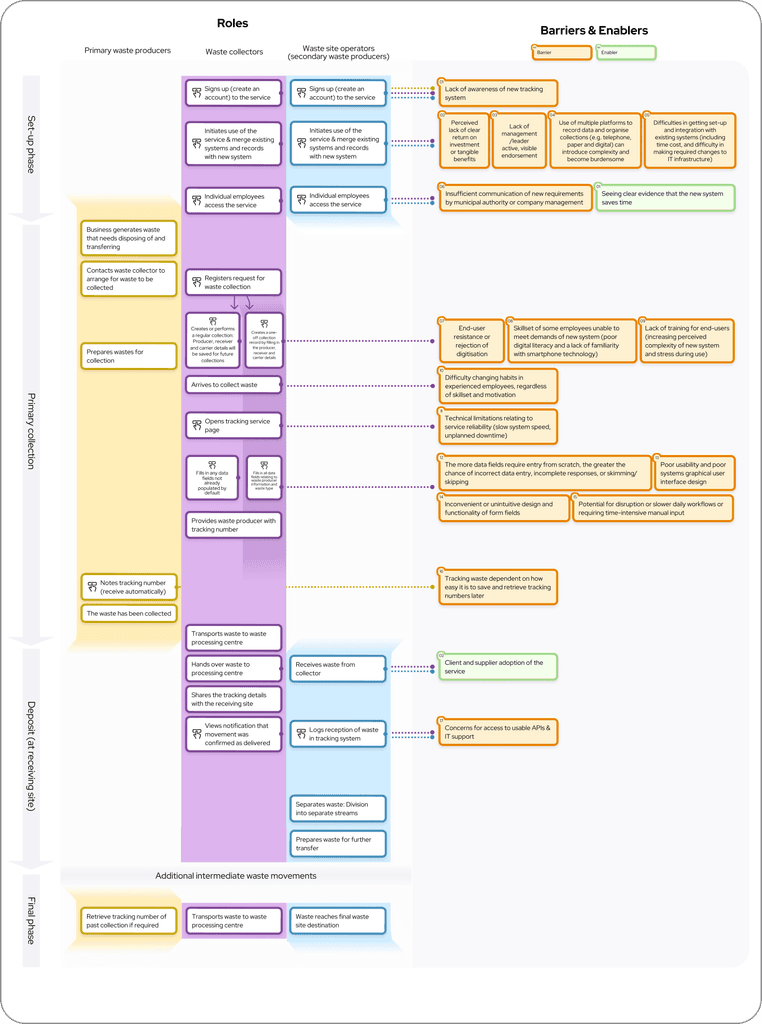
The second looked at understanding the behavioural barriers and enablers of users in relation to a new digital service, and here I developed a behavioural map looking at the use of the new digital service across three different users and the associated barriers and enablers for each action. This asset has provided the policy team with an asset that offers them behavioural insight across specific points of interaction with the new digital service, allowing them to consider how to address the challenges raised.
Department for Environment, Food & Rural Affairs (DEFRA)
Behaviour | Service | Policy
1) Increasing compliance of businesses to a new recycling policy
Solutions and feasibility workshops
After behavioural scientists had conducted a literature review into the relevant behaviours I was responsible for bringing these insights into a usable workshop format and developing a structure for how participants (a range of DEFRA stakeholders) will develop ideas from them. The participants were split into two teams where they brainstormed ideas using CogCo behavioural playbook cards. Ideas were then prioritised and developed using three prompts.
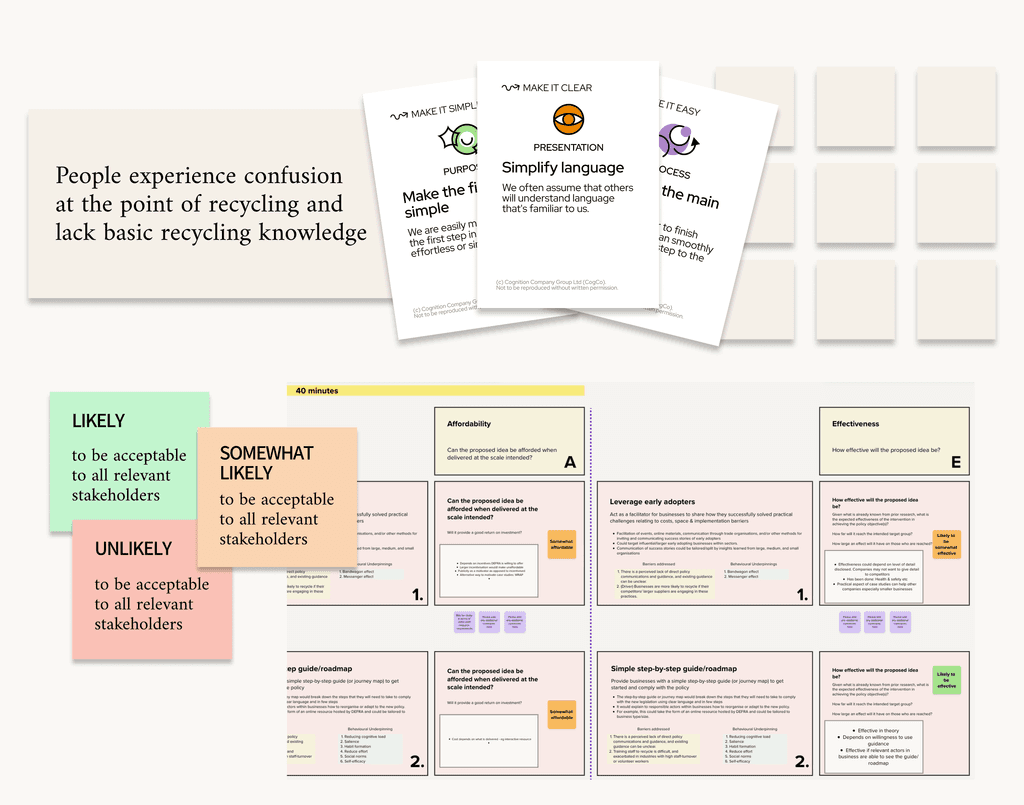
Between the two workshops, myself and the team further developed and prioritised ideas, eventually finalising six to take forward. For the feasibility workshop we used the “APEASE” (Acceptability, Practicability, Effectiveness, Affordability, Spill-over effects, and Equity) framework as a base for participants to vote across each category for each of the six ideas. The output of this was a productive discussion across different expertise of the organisation and saw the group successfully prioritise three ideas to take forward, and three to discard.
Prototyping
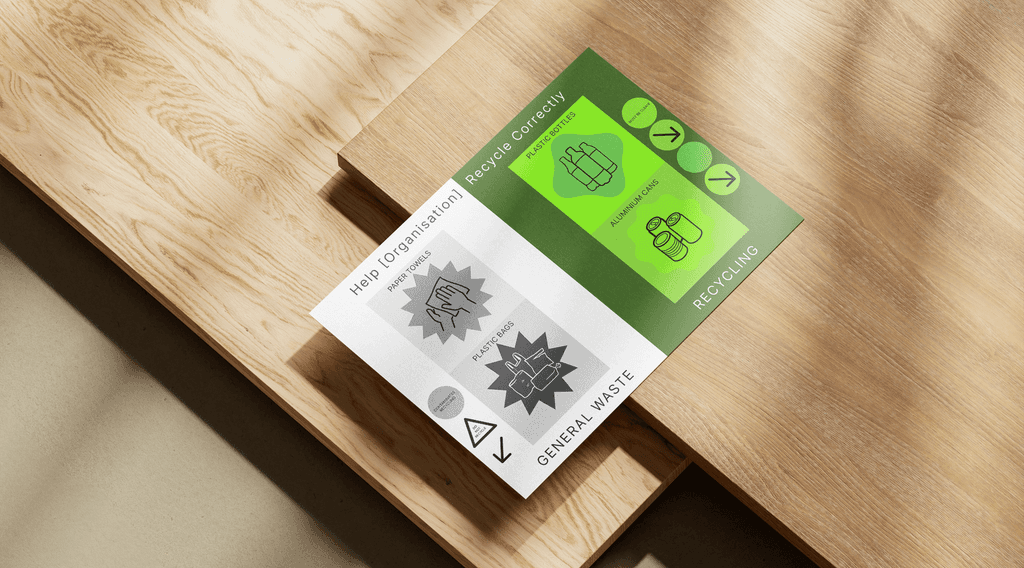
I brainstormed with my other team members, behavioural scientists, how we might represent these different ideas in digital form. I was responsible for understanding their inputs from a behavioural view point and bringing these to life as a digital concept. I visualised three different wireframe flows representing these ideas, and developed a digital poster template which was informed by behavioural insights (e.g. giving simple instructions, and personalising the content) to encourage compliance of the policy.
2) Understanding the behavioural barriers and enablers of users in relation to a new digital service
Behavioural mapping
Using the findings the behavioural team had found from the evidence review, I worked in partnership with them to understand and develop a custom behavioural map. I first helped to assess existing journey maps for three user groups and consolidate the actions into a more simplistic and aligned form. Using Figma I then began to design the map itself, considering structural aspects such as the orientation of user actions, and ensuring all text could be added to the frame, and visual aspects such as spacing between lines and within action boxes, and use of colour. I also had to consider how to align user actions across the three groups with specific behavioural barriers.